Shzu Shzu
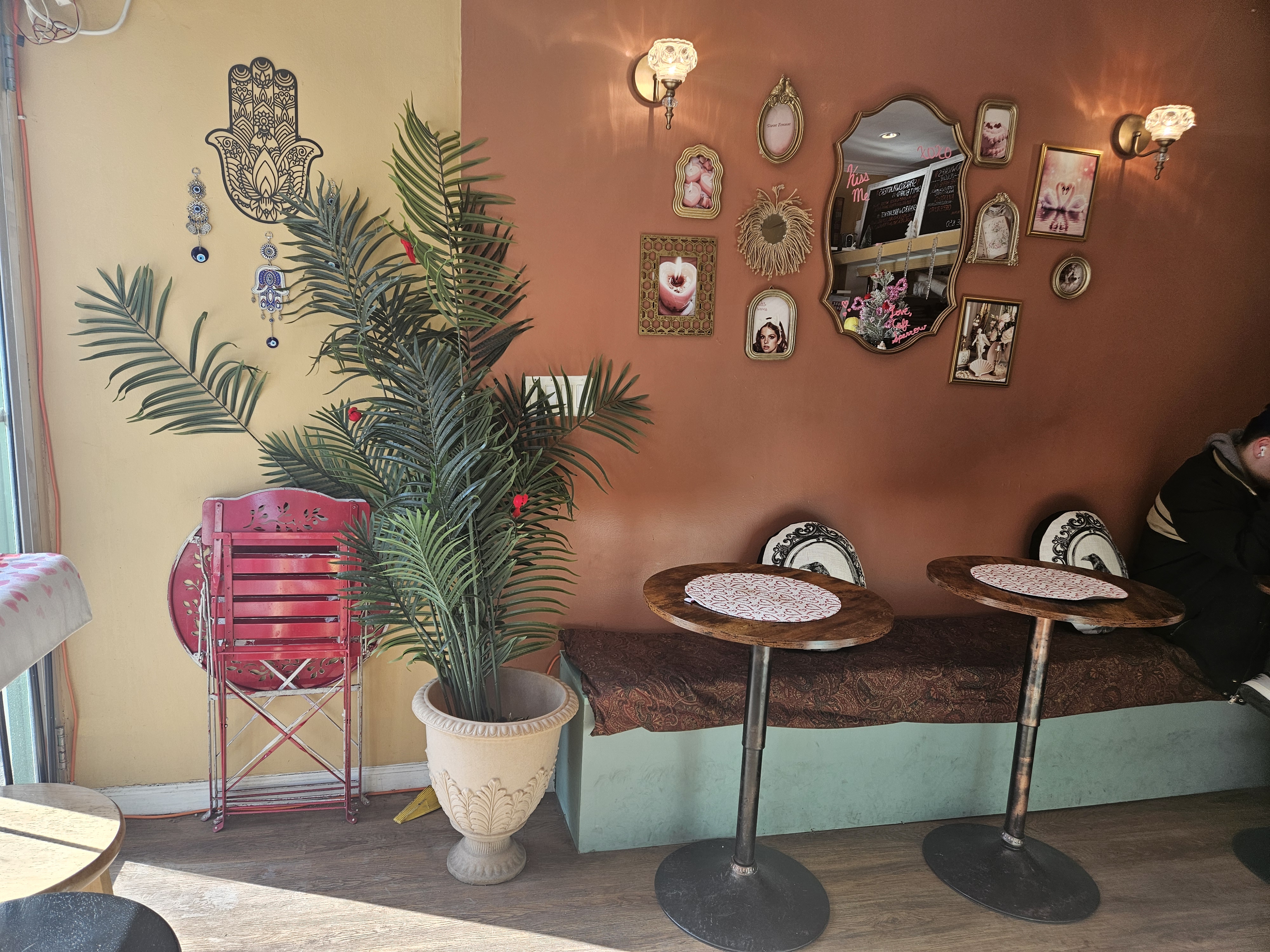
The café was a new one for me, so small it seemed I could hold it in the palm of my hand. It was called, fittingly enough, Café Sparrow. As I sat with my morning coffee and notebook, I was accompanied by the conversation between a man and a woman at a table an arm’s length away. Had I been at my usual café, I would have been overhearing a conversation in Greek. But I was one avenue and seven streets away from my usual spot and in Astoria, that distance takes you over a border into another country.
I suspected they were speaking Serbian. I’ve often thought that if cats developed the ability to speak like a human, the language they would choose would be Serbian. The rolled R’s and the shzu shzu consonants would prove so easy to navigate. As for the breakfasting couple, I loved the sound of their language. I would have asked them what it was. But I was afraid they would think I was from ICE.
Long ago in civics class, we were assigned to write a term paper on one of the federal agencies. (Nearly every part of that sentence is hopelessly quaint.) I chose, as it was then known, the Immigration and Naturalization Service – INS. One of the stated objectives of INS, created by FDR in 1933, was to “supervise the immigration process.” In 2003, as part of the Homeland Security Act, ICE was created – Immigration and Customs Enforcement. One of the stated objectives of ICE is to operate the “removal process.” For “naturalization,” (to become a citizen is to become “natural”), you must go to the U.S. Citizenship and Immigration Services. But you don’t hear much about USCIS, and perhaps I should not have mentioned it.
Some people fond hearing a language that is not English “uncomfortable.” I have in my time been made uncomfortable by language. When I was at CBS, my first job out of film school, my boss used to leer at me with his palm against my neck, “Oh, if I were ten years younger.” This made me uncomfortable. When my father, responding to my complaint about this behavior, replied, “Can’t you put up with it?” I was uncomfortable. When the HR assistant at ABC, shaking her head at my resume which included my degree, two years under siege at CBS, and a novel under contract from a prestigious publisher, told me “Only secretarial positions are available,” I was uncomfortable. (And skeptical.)
But that was language directed at me specifically, and I am using “language” here in the definition “choice of words” not “a system of communication used by a particular country or community.” Although I was made uncomfortable by the latter definition when I worked at an Italian law firm (having switched industries, feeling no love or money from television) and two people conversing in English in front of me, gave me the side-eye and switched to Italian. That behavior was deliberately exclusionary, as opposed to the Serbian couple at Café Sparrow, who were merely conversing.
I wanted to ask merely, “Hey, what language is that? It’s beautiful.” I remember asking a man in a wine store “Are you speaking Portuguese? Such a beautiful language.” I guess I’m not made uncomfortable by the sound of other languages. I guess I have no conclusion to offer that isn’t naïve or too hopeful or too bleak. I guess I am fond of the sound of purrs and shzu shzus.
Where the Streets Have No Name
My friend Lee once sent me a card that came back to her because she had misaddressed the envelope – nearly all the streets in Queens are numbered and many share a number, so that there is a 31st Avenue, Street, Road, and Drive within walking distance of me. All of the roadways once had names, of course, and they were all changed to a numbering system.

In 1898, Queens County decided to consolidate with Manhattan. While Brooklyn was an entire city when it joined Manhattan. Queens was a county of small villages, each with its own Broadway, its own Main, its own Elm.
A one-time official Queens Historian wrote: “By the 1920’s, in order to rationalize the maze of gridlets and ensure connectivity of the system, the Queens topographic bureau imposed an evenly spaced master grid over the entire borough. Streets began in the west in Long Island City and Avenues began in the north in Whitestone. . . named streets followed the contours of the land.”
That does not appease Lee, who still stings from the return of her greeting card. But it was Lee I thought of as I read through the minutes of the Board of Trustees of the Village of Astoria, 1839-1870 last week at the New York City Municipal Archives.
About a year ago, a man whom I don’t know and didn’t ask informed me on social media that the history of Astoria begins with Stephen Halsey. This unasked man is correct, I suppose. The history of the land does not begin with Halsey, but the history of Astoria does – it was incorporated by the New York state legislature in April 1839, and Halsey is the reason it is named Astoria. Halsey was a fur trader who was chummy with John Jacob Astor, which I suppose it was necessary to be if one was a fur trader at that time. But here I will defer to Rebecca Bratspies, a professor of environmental law at CUNY Law School and the author of Naming Gotham: The Villains, Rogues & Heroes Behind New York’s Place Names:
Stephen A. Halsey, founder of the Astoria neighborhood of New York, proposed naming the town after John Jacob Astor in the hopes that Astor would make a large donation to a young ladies’ seminary, which would also be named after him. Astor made the donation, but instead of the generous support Halsey had been hoping for, Astoria donated only $500 to the Astoria Institute . . . Astor himself never visited Astoria, even though he could see it from his country house on the other side of the East River.
Halsey is all over these early years, according to the minutes. I thought that minutes of a board of trustees would be dull reading, that I would be finished by lunch and on my way to the rest of my day off from the office. And they were dull reading – the building of walls, sidewalks, sewers, the maintenance of wells and pumps, the grading of streets, the placement of street lamps, the establishment of a fire department, the naming of a police constable. But they were also fascinating and kept me there until the archives closed, as I read the story of transformation from a bunch of farms and fledging factories being shaped into a town. Many of the early meetings were held in Halsey’s home.
And then I came upon the naming of the streets. Lee would rejoice!
“RESOLVED that a new street sixty feet wide to be designated as “Grand Street” shall be laid out and opened commencing at Welling Street and running in an easterly direction as far as the village limits extend along the line between the lands of C. B. Trafford and B R Stevens on one side and R M Blackwell – Buchanan & Gabriel Marc on the other side . . .”
Also established in these early minutes: Main Street, Flushing Avenue, Newtown Avenue, Sunswick Terrace, Greenock Street, Welling Street, Emerald Street, Linden Street, Woolsey Street and Remsen Street. Grand Avenue (not street) is now a subway stop, Remsen is 12th Street, Welling is Welling Court, Sunswick is a buried creek, and Newtown Avenue is Newtown Avenue. The rest would require some digging.
Certain prohibitions were also introduced: no person shall allow his livestock or fowl to wander at large, set off gunpowder or combustible material in public places, swim in the East River near the ferry slip or appear naked in a public place, or “raise or fly a kite in any street lane or alley within the village under the penalty of Five Dollars for every offence.”
I wondered what the deal was about flying a kite. There were no telephone lines to disrupt in 1848, and I doubt that there were all that many kites. I would have asked the friendly archivist, Marcia, but Marcia, who is from Flushing, had already hurried away to find a law dictionary when I asked her about the Flushing Remonstrance. I know about the Flushing Remonstrance; it was that word “remonstrance” that has bothered me. Were there other famous remonstrances?
There were remonstrances in the board of trustee minutes. A farmer remonstrated that the location of Grand Street would destroy some of his trees. The Hook and Ladder company remonstrated that the proposed Village Hall should not be in the firehouse.
More exciting to me than the evidence of other remonstrances was Marcia, the archivist, who responded to my questions with lots of information – files dug up, an Excel spreadsheet of other sources emailed to me, suggestions as to where other information might be housed. I hadn’t realized how parched I was for a sympathetic ear until she provided a gentle sprinkling of support. Writing is a lonely business at the best of time; writing researched nonfiction when one is not a journalist or historical can seem deranged.
“How’s your history of Astoria coming along?” smirked a work colleague at a recent lunch. Granted, this particular colleague can make the response to a mild “How are you?” sound scathing, but this dash of scorn reminded me to be careful who I tell (as my fellow writer but not relative Joan Frank once advised).
I know, I know. Be grateful for the librarians, the archivists, the other lonely historians, the kind stranger who gave me permission to quote from her PhD thesis on Mark di Suvero. Be grateful, and tell the naysayers (quietly, of course) to go fly a kite.
Kicking and Giving

I have now completed the second week of my fully-remote life. My previous job had a one-day-a-week-in-the-office policy for those of us in IT. For some reason, although I was in the research library, I was umbrellaed under IT. (My inability to master layout in the upgraded version of WordPress tells you allyou need to know about me working in an IT department.) When I asked my boss why the library was IT, his reply was “Gotta put us somewhere,” which effectively sums up what led me to leave that job — the lack of engagement, the listless dismissal of legitimate inquiry. The loneliness. In my new role, I am back to research umbrellaed under business development, which sets the world right again, but it is fully remote. Although this is only the difference of one day a week, it is a mindset which sets the mind reeling. To ward off the loneliness, I have committed myself to Pilates and knitting, two things at which I will be terrible for the foreseeable future, but both of which are within walking distance (there are two knitting groups that meet at different bars. I know one stitch.)
And then daily, I take long walks and write in a coffee shop. There is Chateau le Woof, of course, but nearer to home, so that I can get a walk-and-write in before logging on to work, there are three cafes: Under Pressure, Madame Sou Sou and Astoria Coffee. Under Pressure has a high-tech, sleek European vibe, a business-district-transformed-from-its-industrial-past-near-a-branch-of-the-Guggenheim-and-a-W-hotel kind of Europe. Madame Sou Sou has an Old Town European vibe, a cafe-on-a-narrow-street-full-of-quaint-shops-that-are-always-closed-recommended-by-the-landlady-at-your-AirBnB kind of Europe. Astoria Coffee has no European vibe at all. Extremely small even by NYC standards, it is resolutely Astorian, patriotically displaying on its limited wall space art photos of Astoria taken by local photographers.
But it is at Under Pressure where I set my first scene.
Despite its only-in-town-for-fashion-week interior, its clientele is mainly Greek and mainly working class. There is outdoor seating where you can watch the elevated train go by, or watch people line up to order gyros from the Greek on the Street food cart, or watch a traffic cop strolling down the avenue looking for victims. Under Pressure’s employees are Greek,and if their highly amused reactions at my attempts to greet them in their native tongue are any indication, no amount of living in Astoria will help my accent. I was sitting outside with my coffee and my notebook, earbuds in but podcast off. Three men were seated behind me, Queens natives by their accent, contractors by their conversation.
Guy on phone: “Look, I told you I needed you to have the bathroom done by the end of the week . . . that ain’t my problem. . . do what you gotta do. Come in early, stay late, get it done.”
I returned my focus to my to-do list, writing a list of what needed to be written, which is about all the writing I’ve done during the job transition. I heard a voice say “She’s not friendly,” and a moment later a man walked by, his Shiba Inu on a leash trotting alongside him.
Warning: the language below is foul but accurately recorded.
The first man said, “What the fuck! Not friendly!”

The second man said, “The fuck bring it out in public for if it’s not friendly.”
The third man said, “I’ll kick that fucking dog.”
At this point, I pulled out my earbuds and turned around.
The first man at least looked abashed. “Didn’t think you could hear with those things in.”
I explained that the Shiba Inu is a loyal-owner breed, until a few exchanges compelled me to stop. The second man muttered “Shiba Inu,” like it was a new obscenity to welcome into his lexicon. The dog kicker said “I got a pit bull. He don’t like people, I don’t take him outside.”
I held up my palm in the universarl signal for “I will now exit this conversation” that in this case meant “I have no wish to play the extra in a community theater production of Goodfellas.”
Later in the week, I sat at Madame Sou Sou with my coffee and notebook writing about the Under Pressure encounter when I found myself within earshot of a coffee date, a young American man, a young European woman, awkward (“I like your shoes”) and endearing. He explained that he would spend the next day at a “Friendsgiving” and I happened to lift my head in time to see her tumble the phrase in her mind, extrapolating from her familiarity with “Thanksgiving” as a North American holiday to ask “What is a ‘giving’?” .
As he explained, I entertained the idea of a “giving,” a celebration where people gather out of choice, not obligation, not freighted with travel rushes and mandatory dishes, expectations, disappointments, grudges, too much stuffing, stuffing of everything.
So, my friends, I wish you a good giving. (But no kicking.)
Is there a place that means a lot to you?

Yesterday I conducted the second of my readings/workshop at Chateau le Woof. It was, New York-famously, the seventh consecutive Saturday of rain, so my expectations of attendance were low. Who would venture through more sogginess to attend a reading of a work-in-progress advertised by an admittedly cute but somewhat vague flyer?
Yet, people came. One was my friend Tess, who I met at the VCFA conference last August, her friend Hannah, two kind neighbors, and a woman who I met in the most interesting manner. This work-in-progress has been a work-in-progress, as I shift and distill its focus from so many tantalizing possibilities. Initially, I began visiting the Chateau le Woof (aka “the dog cafe”) just after the vaccines were rolling out, in the late spring of 2021. I was privileged enough to be able to work from home, but also stir-crazy enough to need to be somewhere other than my home, with other people, yet not indoors. The dog cafe, an indoor-outdoor space, was perfect. I reflected on how we had quarantined ourselves during this pandemic, but during previous epidemics, New York City had quarantined the sick on the islands surrounding Astoria — Roosevelt Island, previously known as Welfare Island and before that Blackwell’s Island, had been home to hospitals, jails, poorhouses and a notorious lunatic asylum. North Brother Island had been home to a tuberculosis hospital. Hart Island was a potter’s field begun after the Civil War and in active use during the height of the pandemic, where graves were dug for the unclaimed dead by the unhappy residents of Riker’s Island.
I still have a draft of that chapter — “Exiles of the Smaller Isles” — but realized I could not use the background research I’d done on Typhoid Mary. She was sentenced to life on North Brother Island, not in the tuberculosis hospital (where she worked as a lab assistant) but in her own small cottage from which, in the imagination of novelist Mary Beth Keane in her novel FEVER, Mary falls asleep to the sound of the rushing currents of the Hellgate, a rapid, still-dangerous stretch of the East River between Ward Island and Astoria. FEVER is an excellent if bleak novel detailing the options of an unmarried immigrant woman at the end of the 19th century. At one point, the caretaker on North Brother Island points out to Mary that her life in her tiny cottage with her little dog, however lonely and powerless, is still much better than some have it.
My favorite of these books was TYPHOID MARY: AN URBAN HISTORICAL which was surprisingly hard to get a hold of, considering its author, Anthony Bourdain. It is top-of-the-game Bourdain, scathing and snappy, but I had to get it on Kindle, because it may be out of print. So it was not among the stack of books I took to the closest Little Free Library. I deposited them and at the same time was delighted to see that the small wooden box held a copy of UNCOMMON GROUNDS, a history of coffee, which was on my list of books I needed for research.
Another woman browsing the Little Free Library eagerly grabbed ALL the Typhoid Mary books, with such enthusiasm that I tilted my head at her. She explained that she was an epidemiologist with the New York City Department of Health.
“So . . . how was your pandemic?” I asked.
She attended the reading, along with her friend, another epidemiologist.
I started keeping this blog such a long time ago that I forget my own logline sometimes, which ends with “champion of the chance encounter.” This was one, if ever there was one.
My Year in Reading 2022

I’m still working on expanding my reviewing, and was fortunate to land a new gig, so I’m looking forward to more in the coming year. I reviewed three books this year. They are therefore disqualified (and indicated in italics) from my top ten. I’ve also ordered several books written by friends but they may still be in the TBR pile, or not yet finished.
So, with the downtime I had at my disposal, excluding periodicals, and listening to podcasts excluded, here are the books:
For research
Typhoid Mary: An Urban Historical – Anthony Bourdain
Terrible Typhoid Mary – Susan Campbell Bartoletti
Deadly – Julie Chibbaro
The Lonely City – Olivia Laing
Open City – Teju Cole
Feral City – Jeremiah Moss
New York City Coffee: A Caffeinated History – Erin Meister
The Power Broker – Robert Caro
John Winthrop – Francis J. Bremer
Eye of the Sixties: Richard Bellamy of the Transformation of Modern Art – Judith E. Stein
The Architecture of Happiness – Alain de Botton
Mark di Suvero (edited by David R. Colleens, Nora R. Lawrence, Theresa Choi)
Work on the work-in-progress progresses, so I have started on readalikes. I’ve realized that there really is no way to tie in Typhoid Mary to the conceit of my book, but I have now read enough on her to consider myself an amateur expert. Halfway through the year I shifted my focus to Mark di Suvero, subscribed to Art in America, downloaded every article I could find at NYPL, and solicited a box of di Suvero family papers from the Smithsonian. And still I know so little that eking out 500 words took all I had.
All that said, The Power Broker occupied weeks and weeks of reading, even with using the audiobook. That book is long. I also saw the David Hare play, Straight Line Crazy, so I’m just about as up on Robert Moses as I am on Mary Mallon.
Reading resolution for this category: Continue with Mark di Suvero. Read other living Queens authors extensively for a workshop I hope to hold, with grants I hope to be granted.
Fiction
Five Tuesdays in Winter – Lily King
The Last True Poets of the Sea – Julia Drake
The Latecomer – Jean Hanff Korelitz
An Honest Living – Dwyer Murphy
Tinker Tailor Soldier Spy – John Le Carre
Mercury Pictures Presents – Anthony Marra
Fellowship Point – Alice Elliott Dark
Natural History – Andrea Barrett
Shrines of Gaiety – Kate Atkinson
About Face – William Giraldi
Trust – Hernan Diaz
Trust Exercise – Susan Choi
I was surprised to see so few novels on my list, again, The Power Broker took up a lot of my summer. I was sad to leave the Lily King and the Kate Atkinson off my top ten list, but the memoirs below just nudged them out. The Marriage Portrait is in the queue.
Reading resolution for this category: See Queens authors, above. Otherwise, I will probably graze indiscriminately.
Memoir
Bluets – Maggie Nelson
H is for Hawk – Helen MacDonald
The Outrun – Amy Liptrot
Also a Poet – Ada Calhoun
The Lost Children of Mill Creek – Vivian Gibson
Easy Beauty – Chloe Cooper Jones
The Odd Woman and the City – Vivian Gornick
Reading resolution for this category: Don’t really have one? Crying in H Mart is waiting for me at the Astoria Library.
Essays
Animal Bodies – Suzanne Roberts
Orwell’s Roses – Rebecca Solnit
Like Love – Michele Morano
Hysterical – Elissa Bassist
Festival Days – Jo Ann Beard
All the Leavings – Laurie Easter
Bright Unbearable Reality – Anna Badkhen
Reading resolution for this category: I hope to review more in this category. I focus on collections published by indie and university presses.
Craft
Craft in the Real World – Matthew Salessas
A Swim in the Pond in the Rain – George Saunders
How to Write One Song – Jeff Tweedy
Reading resolution for this category: I am starting 2023 with a poetry workshop which has two rather daunting required texts, so, dare I say, I am good here?
Other nonfiction
Islands of Abandonment – Cal Flyn
The Strange Case of Dr. Couney – Dawn Raffel
Reading resolution for this category: I realize that this category is composed of writers with whom I took workshops in 2022, both of whom were super-kind and thoughtful.
Poetry
The Owl Was a Baker’s Daughter – Gillian Cummings
Long Rules – Nathaniel Perry
Reading resolution for this category: More, more, more.
Cozy old things and mysteries
Cheerfulness Sets In – Angela Thirlkill
The It Girl – Ruth Ware
The Madness of Crowds – Louise Penny
Dying to Tell – Robert Goddard
Reading resolution for this category: this is the “something fun to read” category. It defies resolve.
Happy reading in 2023 to all!
A Sense of Place

Hello readers:
As one of the recipients of a #NYCArtist Corps grant, I did a reading last weekend of my work in progress, “40 Days at the Dog Cafe,” at the market adjacent to the dog cafe, Marche le Woof. After my reading, I conducted a workshop called “A Sense of Place,” inspired by the fact that I was inspired by the dog cafe, Chateau le Woof, to begin writing about my changing neighborhood, over the summer.
I am toying with the idea of offering a regular, free, low-key generative writing workshop for writers of all levels. The workshop was my favorite part of an already rewarding day. Here is the “teacher’s edition” of the handout I provided the participants. Let me know what you think in the comments.
A Sense of Place
A Chateau le Woof workshop
When we read stories, we often don’t think of place as a primary element. In the earliest stories we heard, place hardly mattered at all. The story happened in a place – far away? enchanted? A kingdom? A village on the edge of a dark forest? A cottage by the sea? We had just enough to orient ourselves.
When we think of stories, we think of plot, characters, and the rise and fall of action. If we think of place at all, we think of where a story “takes place.” To Kill a Mockingbird takes place in Alabama, or, if you move in, in a small town in Alabama where everyone knows everyone else, or, if you move in more closely, on the front porch of the Finch household and in a courtroom.
A Game of Thrones takes place in the Seven Kingdoms, in Westeros, in King’s Landing, and in the throne room where the frankly ugly chair that everyone is fighting for actually sits.
But I’d like to explore how place can serve a story. How it can act as character, or metaphor, or place setting. Place setting is most common in the movies, where a bleak western landscape or a busy heartless city can set up a conflict for the hero. something to conquer.
But place can also be one of the main characters. the examples below are from essays. Let’s see how descriptions of place can be used.
PLACE AS CHARACTER
Somehow you are supposed to teach yourself how to comprehend Hong Kong’s energy and flash contradictions; Asian and Western; the encroaching Chinese mainland and the remnants of England; the greasy night markets of stick-rice tamales and knock-off leather boots that slouch right across from Tiffany, Chanel, and Prada. The only things common to these are the offices sending air-conditioned blasts into the street, a kind of longing for money, and, most important, the sense of storytelling that the city seems to require as a visitor’s pass. Hong Kong has a way of turning on your internal monologue. Walking becomes an act of silent storytelling, figuring people out. You feel like you are lost in some prelapsarian novel in which the plot has begun but the characters wait for you to name them. In some time, at some place, we step into an underground Cantonese restaurant and I see a grey-suited, red-tied man act like a parody of the States. American, I say, with an American accent: good-natured smiles, occasionally the slow English dispatched on foreigners and children, and a slightly uncomfortable look, as though he’s worried he’s outnumbered.
Ken Chen, “City Out of Breath,” 2005
This essay by Ken Chen describes a visit he made with his father to Hong Kong. His father spoke Mandarin but not Cantonese. Is Hong Kong a character? Perhaps an antagonist?
Once I loved a man who was a lot like the desert, and before that I loved the desert. It wasn’t particular things but the space between them, that abundance of absence, that is the desert’s invitation. There the geology that underlies lusher landscapes is exposed to the eye, and this gives it a skeletal elegance, just as its harsh conditions—the vast distances between water, the many dangers, the extremes of heat and cold—keep you in mind of your mortality. But the desert is made first and foremost out of light, at least to the eye and the heart, and you quickly learn that the mountain range twenty miles away is pink at dawn, a scrubby green at midday, blue in evening and under clouds. The light belies the bony solidity of the land, playing over it like emotion on a face, and in this the desert is intensely alive, as the apparent mood of mountains changes hourly, as places that are flat and stark at noon fill with shadows and mystery in the evening, as darkness becomes a reservoir from which the eyes drink, as clouds promise rain that comes like passion and leaves like redemption, rain that delivers itself with thunder, with lightning, with a rise of scents in this place so pure that moisture, dust, and the various bushes all have their own smell in the sudden humidity. Alive with the primal forces of rock, weather, wind, light, and time in which biology is only an uninvited guest fending for itself, gilded, dwarfed, and threatened by its hosts. It was the vastness that I love and an austerity that was also voluptuous. And the man?
Rebecca Solnit, “A Field Guide to Getting Lost,” 2005
This essay by Rebecca Solnit describes a landscape and a love affair. She ends the passage with the question, “and the man?” but what do we already know about the man, from the way she described the desert? Is he fat or lean? iI the sex good? Is he emotionally available? What clues do we have?
PLACE AS TABLE-SETTING
In the bar up ahead waitresses slam sloe-gin fizzes down on wet tables and men point pool cues at each other in the early stages of drunkenness. The singer in the three-man band whispers test into the microphone and rolls his eyes at the feedback. The sound guy jumps up from a table full of ladies and heads over to turn knobs.
We crunch over the parking lot gravel and wait for our song to finish. I’m over my head, but it sure feels nice. The bar is low and windowless, with patched siding and a kicked-in door; the lot is full of muscle cars and pickups. A man and a woman burst through the door and stand negotiating who will drive. He’s got the keys but she looks fiercer. In the blinking neon our faces are malarial and buttery. As the song winds down, the drama in front of us ends. He throws the keys at her as hard as he can but she jumps nimbly out of the way and picks them up with a handful of gravel, begins pelting his back as he weaves into the darkness.
Jo Ann Beard, “Cousins,” 1995
Where are we? When are we? What do we make of the fact that the writer describes what’s going on in the bar before she and her companion even arrive? What kind of evening is going to unfold, and how do we know?
PROMPTS
1.
Whenever the experiment on and of
My life begins to draw to a close
I’ll go back to the place that held me
And be held.
Jane Mead, I Wonder if I Will Miss the Moss
Write about a place that held you, how it held you, what it felt like to be held there.
2.
Art is energy, held in a form long enough to be experienced.
Kim Addonizio
Write about a place the gives or gave you energy, that inspires or inspired you. (It doesn’t have to be artistic inspiration – it could have inspired you to make a move, or a declaration.)
3.
Write about anything you like.
Boats Against the Current
And still we keep on creating, though myself not as much I would like of late. Lacking friends with benefits, I turned earlier this summer to friends with books out.

Marcia Trahan’s memoir Mercy: A Memoir of Medical Trauma and True Crime Obsession explores her own medical ordeals, her obsession with true crime on television, women’s bodies as commodities in society, and her own identity. Sue William Silverman’s How to Survive Death and Other Inconveniences, a memoir in essays, explores assault and addiction, and masterfully illustrates how trauma can stalk a person’s life, sometimes in brief shadow, sometimes in full-blown flashback.
I like to call Lee Martin’s recent fiction “Southern Illinois Noir,” although whether he likes me to call it that is not something I have asked. In his recent novels and story collections, momentarily untethered people make rash decisions that lead to outsized consequences; sometimes, as in his recent Yours, Jean, based on a true crime, an entire town acts as both chorus and cast.
There has been little progress on my own work, except for publicity for and correction of the proof of Censorettes. While I have little to complain about (I know; I am lucky!), how rarely that stops me. I am able to work from home, and I am putting in more hours than ever, including Sunday afternoon, which at least provided peaceful, uninterrupted time. I am attending a virtual writing conference next week, and need to get my day job ducks in a row.
Once I was done, a walk to the park was in order. My new favorite place is Chateau Le Woof, because I love the ingenuity the owners had of turning a former industrial parking garage into a dog-friendly cafe, open to the street, across from the park. On the way there, I met a woman and her dog. The owner and I nodded, but the dog did a full-fledged double take and pulled her back to where I was sitting. “YOU AGAIN!” he would have cried, had we both been human, and cast in a romantic comedy where in an earlier scene I would have stolen his parking spot, or spoiled some meticulously prepared model just before the big presentation. He gazed at me with ardent brown eyes through dirty white fur.
“Hi,” I said to the dog, as his owner tried to break his stare and pull him along, chuckling apologies to me. I said to the dog, “Hot out, right?” and then, as a man walked by, “Okay, I’m really not that interesting. Try that guy.”
Because of allergies, I’m not a petter of strange dogs, particularly ones who regard me like an antic Cary Grant regarding the leopard, if not Katherine Hepburn, in Bringing Up Baby.
Then, I said to the dog, “Alright,” and got up to walk with them to the park.
“You a Vermonter?” asked the woman.
Strange question, I thought, until I looked down and realized I was wearing a Vermont t-shirt. I still think it is a strange question. People don’t necessarily wear t-shirts advertising their home, so they can be returned if life becomes wayward. People visit places and buy t-shirts to show they were there; there is even a cliché about it. But I once wore a t-shirt I bought in Canada on a Brooklyn riverside bike tour, and people kept asking me what province I was from, or telling me how much they liked Quebec.
The woman was herself from Burlington. I told her, then, about Vermont, how I attend the Vermont College of Fine Arts Postgraduate Conference in Montpelier, Vermont every summer (where I met the above authors, Lee, Marcia and Sue), how this year it is virtual, which means I am not at my picnic table on the town green at the top of the hill, or hanging out in the Cafe Anna with my friends, but in my apartment, in my same crippling home desk chair, a captive of Zoom, with pandemic hair and bad lighting (I know; I am lucky!)
Maybe I am a Vermonter.
We turned the corner on Vernon Boulevard, where some string players were entertaining an insufficiently socially distanced group and their dogs.
My canine love interest took off across the park, a sculpture park, which is currently home to this monolith.

“Because Once You Enter My House, It Becomes Our House,” by Jeffrey Gibson. Read more about it here
The music of the strings lured me out of the park and I stood among my insufficiently socially distanced neighbors, enriched that day by so much heat and creativity. We are isolated; still, we create. We are ordered to keep a distance; still, we connect. We experience ordeals and suffer from bad decisions; still, we write books (albeit ones with blood-splattered covers).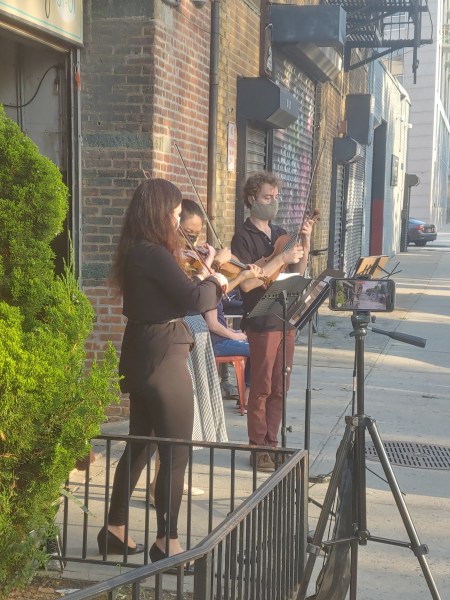
The string players launched into I Can’t Help Falling in Love with You, alternating the melody line, first the pizzicato, then the legato. We all grew very still and drank it in. We knew we were lucky.
Saint Behind the Glass
Screen to screen to screen has been my life this past month — my work laptop, augmented by my personal laptop, and then my desktop, when the workday is through, followed by some viewing on my laptop again. I am privileged to be able to work from home and to live in a co-op building which is well-maintained. But as I have revealed, I have taken to gazing out my window. 
Now straight ahead, dead straight, to the left of the streetlight and to the right of the bright window in the building across the street, you can see a bit of colored glass. There. You see it? Had I an actual camera (instead of a phone) or were I a better photographer, I could capture that image — the streetlight, the stained glass of the Ukrainian church beyond.
Last night, I attempted it. The bars of the fire escape were too intrusive and the zoom on the cell phone camera wasn’t sufficient, so I climbed out on the fire escape and did my best.

This yellow-robed Ukrainian saint has been gazing into my living quarters for the past 20 years, but I only thought to think of it now. Of course, I was aware that there was a Ukrainian Orthodox Church a block away — I have photographed their fete on Ukrainian heritage day. Beribboned children in native costume dance all afternoon in reluctant troupes. Ornately braided girls and grim embarrassed boys prance and clap on a wooden platform in front of the church, to the blaring of recorded accordion and clarinet music. A street block is roped off from traffic to allow for tables selling embroidered goods and meat-stuffed pastries, and chairs for the parents of those mortified, loyal prepubescents.
These wares, these performances, are not meant for the likes of me. I don’t know the difference between Greek Orthodox and Ukrainian Orthodox but I know neither proselytizes. Far from it. It is from the Greeks that we get the word “xenophobia,” from the Greek xenos meaning “foreigner” or “stranger.” Also, “barbarian,” which originally meant “a person who does not speak Greek.” (Non-Greek sounded to Greeks like someone saying “bar bar bar.”)
After twenty years in Astoria, I was not keen to insert myself where I was not welcome.
It took a pandemic to make me realize that the church I look out on every day was not merely a church, but a religious residence. The low tan building I look out on (and appreciate, since it affords me sunlight when a commercial building would not) is not just extra church space, but a dormitory for the order.

Looks Like an Inside Job
Queens Gazette which, in case you have mislaid your copy, details the destruction of a piano which was placed in Athens Square Park by the nonprofit group Sing for Hope. As a summertime public art project which has become a kind of New York tradition (the cows, the Gates, the waterfalls), Sing for Hope has placed sixty pianos in public places around the five boroughs. “Play Me, I’m Yours!” the pianos invite.
One piano was placed in Athens Square Park in Astoria, home of the Steinway piano factory, the last active piano factory in New York City, which in the 19th century numbered 171. The last factory to close was the Sohmer factory, on Vernon Boulevard in Astoria, which closed in 1982, spent some time as an office furniture warehouse, and was declared an historic landmark in March, 2007, and has been in the process of being converted into condos for the past couple of years delayed, I can only surmise, by the credit crunch of the recession. If you have visited Socrates Sculpture Park, you have seen the former Sohmer factory with its landmark mansard-roofed clock tower. Sohmers are not Steinways, but they are nothing to sneeze at. When Irving Berlin wrote, “I Love a Piano,” he write it on a Sohmer.
Here is a photo and an excerpt from the fascinating (especially if you are a geek about the history of neighborhoods) report from the Landmarks Preservation Commission.
Why do I know all this? A few weeks before that factory was declared an historic landmark, I found a Sohmer piano put out on the street for Saturday large trash pickup. I have written about it hereand am also developing it into a larger piece because, how can I put this, I just love pianos. I still have the Sohmer I rescued from the street, even though the soundboard is ruined and several of the keys don’t work at all. I have not come up with the $8,000 I need to have it fully restored to its former glory. But I can’t let go.
“The badly vandalized piano at Athens Square Park, 30th Street and 30th Avenue,” reads the article in the Western Queens Gazette, “had all of its keys and part of its inner gears removed.”
Indeed. The vandalism is quite specific and specialized. The piano was not smashed, axed, beat up, beat in, set on fire or otherwise generally molested. But its keys and part of its inner gears were removed. This particular neighborhood is full of retired tuners and technicians. The violated piano was a Kimball, a Chicago-based manufacturer. The vandal carefully removed the keys from their supporting nails and left the frame. But why, as Keith Morrison on Dateline NBC would ask, why would anyone do that?
Originally published Wednesday, June 30, 2010
The Social Worker
The holiday party held annually in the lobby of my building took place yesterday and provided an excellent opportunity to observe the changing demographic of the building. More young people are moving in, particularly young people starting families. There are two Jennifers, each with a newborn baby and a shy, kind-eyed husband. This is all good, in a bittersweet way. It is desirable to have young people about, and it is best if a co-op is occupied one hundred percent by owners but as I wrote last year, the disappearance of the old people makes me one of the old people.
I went down to the lobby with my neighbor Michael who knows more of the neighbors than I ever will. “That’s ‘cause you work,” he told me, which was, until recently, true. “I’m around all the time.” It is also because Michael, as the saying goes, could charm a dog off a meat truck.
For example, I introduced myself to a neighbor I thought was new to the building and learned she has lived here for two years, that she has a cool job in the music industry, and that she bathes her cat every day with some allergen-killing shampoo. She is a cute, chipper young woman with the sturdy, compact build of a gymnast because, as I later learned, she spent two decades performing gymnastics.
She had vaulted over to the hors d’oeuvres when Michael and I were approached by someone who was new to the building. He told us his apartment number. Michael, who goes to every open house the building holds and has the blueprints of the whole place locked in his memory, informed me, “That’s the old Melman place.”
“Ooooooh.” I turned and tried to get an impression of the new guy: dark hair, dark eyes, dark shirt, black jeans, an unplaceable accent. “Mr. and Mrs. Melman. They died within a day of each other. She died and then he died the next day.”
My new neighbor looked distressed.
“No, it’s romantic,” I assured him. “They were married for like 70 years. They were like Cathy and Heathcliff.”
“If Cathy and Heathcliff were two short old Jewish people,” Michael added. “So, what do you do for a living?”
This was unusually blunt: for the party, for Michael, for the stage of the conversation we were in. But yet, there was something about the new guy that solicited a demand for an explanation. Who was he?
“I’m a social worker,” he said.
“Oh? Where?”
“In a clinic. In New Jersey.”
“Long commute.”
“I have a car.”
Oh, do you? Michael and I nodded and withheld the unasked questions. Among them: How can a social worker afford a car andthe old Melman place, a two-bedroom on the top floor? And Do you live there alone? And God, the place must be pristine! The same tenants for 50 years and then newly renovated! And What is your accent? And Why are you pretending to be a social worker?And “in New Jersey”? Could you possibly be less specific? AndWhy is the aura of intrigue about you as palpable as fog? And Can we go see your apartment? Now?
We are all dying to get into one another’s apartments. The units named after the first dozen letters of the alphabets all have unique layouts: the studios, the compact one-bedrooms, the wastefully large one-bedrooms and the highly coveted two-bedrooms. The units named after the next dozen letters of the alphabet, on the other side of the lobby, follow the same patterns, only flipped. Even if your apartment is exactly the same as that of your neighbor, even, if, oh, say you were to lock yourself out of your apartment when the door slams shut behind you on your way to take out the recycling and you have to cajole the woman downstairs into letting you cross through her apartment and climb out her window onto the fire escape so you can break into your own apartment through the living room window, you would still pause and marvel at what she had done with the space, how she had met the challenges of the literal nooks and crannies that all the apartments have. It is a pre-war building filled with the quirks and perks of the time: built-in bookcases, high archways, deep closets, meandering hallways, foyers, occasionally, a raised dining area just off the kitchen.
The Gymnast bounded back and we introduced her to the Social Worker. I added, after some preliminary chatting, “He bought the old Melman place.”
“Oh! They died within a day of each other!” she told him pertly.
“Did they die in the apartment?” he asked, understandably apprehensive at the party line on his new place.
“No.” I then realized I had no idea. Mrs. Melman had been in the hospital, but who knew about Mr.? Ambulances are a routine sight outside the building. When we ask “Who is it?” of a neighbor watching the EMS workers unload the gurney onto the sidewalk, the answer is usually given by apartment number, as in “Who is it?” “5N.” “At least, I . . . don’t think so.”
“Um, I um . . . cheese . . . right back . . .”
The Social Worker headed toward the refreshment table.
“That guy is not a social worker,” I said.
“I was thinking the same thing,” said the Gymnast. “There’s something just, like — ”
“He’s a spy, obviously.” I’ve been reading a lot of Alan Furst’s novels recently. “But not a very good one. Because spies should try to blend in more. Like those Russians in New Jersey.” (New Jersey!) “There’s nothing about him that says ‘social worker.’ What everything about him says is ‘international man of mystery.’”
As it happened, when I left the party, the international man of mystery joined me in the elevator and carefully asked me to repeat my apartment number.
“I’ve been thinking about having a gathering,” he said. “In my apartment.”
“Oh!” I was pleased that one of the young people would consider inviting me to a gathering, that I was not yet manifestly one of the old people; pleased, also, that I would get to see the old Melman place. “That would be nice.”
Only later did I realize – he never said what kind of “gathering.”
First published Monday, December 20, 2010
 Elizabeth Bales Frank
Recent Comments