Is there a place that means a lot to you?

Yesterday I conducted the second of my readings/workshop at Chateau le Woof. It was, New York-famously, the seventh consecutive Saturday of rain, so my expectations of attendance were low. Who would venture through more sogginess to attend a reading of a work-in-progress advertised by an admittedly cute but somewhat vague flyer?
Yet, people came. One was my friend Tess, who I met at the VCFA conference last August, her friend Hannah, two kind neighbors, and a woman who I met in the most interesting manner. This work-in-progress has been a work-in-progress, as I shift and distill its focus from so many tantalizing possibilities. Initially, I began visiting the Chateau le Woof (aka “the dog cafe”) just after the vaccines were rolling out, in the late spring of 2021. I was privileged enough to be able to work from home, but also stir-crazy enough to need to be somewhere other than my home, with other people, yet not indoors. The dog cafe, an indoor-outdoor space, was perfect. I reflected on how we had quarantined ourselves during this pandemic, but during previous epidemics, New York City had quarantined the sick on the islands surrounding Astoria — Roosevelt Island, previously known as Welfare Island and before that Blackwell’s Island, had been home to hospitals, jails, poorhouses and a notorious lunatic asylum. North Brother Island had been home to a tuberculosis hospital. Hart Island was a potter’s field begun after the Civil War and in active use during the height of the pandemic, where graves were dug for the unclaimed dead by the unhappy residents of Riker’s Island.
I still have a draft of that chapter — “Exiles of the Smaller Isles” — but realized I could not use the background research I’d done on Typhoid Mary. She was sentenced to life on North Brother Island, not in the tuberculosis hospital (where she worked as a lab assistant) but in her own small cottage from which, in the imagination of novelist Mary Beth Keane in her novel FEVER, Mary falls asleep to the sound of the rushing currents of the Hellgate, a rapid, still-dangerous stretch of the East River between Ward Island and Astoria. FEVER is an excellent if bleak novel detailing the options of an unmarried immigrant woman at the end of the 19th century. At one point, the caretaker on North Brother Island points out to Mary that her life in her tiny cottage with her little dog, however lonely and powerless, is still much better than some have it.
My favorite of these books was TYPHOID MARY: AN URBAN HISTORICAL which was surprisingly hard to get a hold of, considering its author, Anthony Bourdain. It is top-of-the-game Bourdain, scathing and snappy, but I had to get it on Kindle, because it may be out of print. So it was not among the stack of books I took to the closest Little Free Library. I deposited them and at the same time was delighted to see that the small wooden box held a copy of UNCOMMON GROUNDS, a history of coffee, which was on my list of books I needed for research.
Another woman browsing the Little Free Library eagerly grabbed ALL the Typhoid Mary books, with such enthusiasm that I tilted my head at her. She explained that she was an epidemiologist with the New York City Department of Health.
“So . . . how was your pandemic?” I asked.
She attended the reading, along with her friend, another epidemiologist.
I started keeping this blog such a long time ago that I forget my own logline sometimes, which ends with “champion of the chance encounter.” This was one, if ever there was one.
Boats Against the Current
And still we keep on creating, though myself not as much I would like of late. Lacking friends with benefits, I turned earlier this summer to friends with books out.

Marcia Trahan’s memoir Mercy: A Memoir of Medical Trauma and True Crime Obsession explores her own medical ordeals, her obsession with true crime on television, women’s bodies as commodities in society, and her own identity. Sue William Silverman’s How to Survive Death and Other Inconveniences, a memoir in essays, explores assault and addiction, and masterfully illustrates how trauma can stalk a person’s life, sometimes in brief shadow, sometimes in full-blown flashback.
I like to call Lee Martin’s recent fiction “Southern Illinois Noir,” although whether he likes me to call it that is not something I have asked. In his recent novels and story collections, momentarily untethered people make rash decisions that lead to outsized consequences; sometimes, as in his recent Yours, Jean, based on a true crime, an entire town acts as both chorus and cast.
There has been little progress on my own work, except for publicity for and correction of the proof of Censorettes. While I have little to complain about (I know; I am lucky!), how rarely that stops me. I am able to work from home, and I am putting in more hours than ever, including Sunday afternoon, which at least provided peaceful, uninterrupted time. I am attending a virtual writing conference next week, and need to get my day job ducks in a row.
Once I was done, a walk to the park was in order. My new favorite place is Chateau Le Woof, because I love the ingenuity the owners had of turning a former industrial parking garage into a dog-friendly cafe, open to the street, across from the park. On the way there, I met a woman and her dog. The owner and I nodded, but the dog did a full-fledged double take and pulled her back to where I was sitting. “YOU AGAIN!” he would have cried, had we both been human, and cast in a romantic comedy where in an earlier scene I would have stolen his parking spot, or spoiled some meticulously prepared model just before the big presentation. He gazed at me with ardent brown eyes through dirty white fur.
“Hi,” I said to the dog, as his owner tried to break his stare and pull him along, chuckling apologies to me. I said to the dog, “Hot out, right?” and then, as a man walked by, “Okay, I’m really not that interesting. Try that guy.”
Because of allergies, I’m not a petter of strange dogs, particularly ones who regard me like an antic Cary Grant regarding the leopard, if not Katherine Hepburn, in Bringing Up Baby.
Then, I said to the dog, “Alright,” and got up to walk with them to the park.
“You a Vermonter?” asked the woman.
Strange question, I thought, until I looked down and realized I was wearing a Vermont t-shirt. I still think it is a strange question. People don’t necessarily wear t-shirts advertising their home, so they can be returned if life becomes wayward. People visit places and buy t-shirts to show they were there; there is even a cliché about it. But I once wore a t-shirt I bought in Canada on a Brooklyn riverside bike tour, and people kept asking me what province I was from, or telling me how much they liked Quebec.
The woman was herself from Burlington. I told her, then, about Vermont, how I attend the Vermont College of Fine Arts Postgraduate Conference in Montpelier, Vermont every summer (where I met the above authors, Lee, Marcia and Sue), how this year it is virtual, which means I am not at my picnic table on the town green at the top of the hill, or hanging out in the Cafe Anna with my friends, but in my apartment, in my same crippling home desk chair, a captive of Zoom, with pandemic hair and bad lighting (I know; I am lucky!)
Maybe I am a Vermonter.
We turned the corner on Vernon Boulevard, where some string players were entertaining an insufficiently socially distanced group and their dogs.
My canine love interest took off across the park, a sculpture park, which is currently home to this monolith.

“Because Once You Enter My House, It Becomes Our House,” by Jeffrey Gibson. Read more about it here
The music of the strings lured me out of the park and I stood among my insufficiently socially distanced neighbors, enriched that day by so much heat and creativity. We are isolated; still, we create. We are ordered to keep a distance; still, we connect. We experience ordeals and suffer from bad decisions; still, we write books (albeit ones with blood-splattered covers).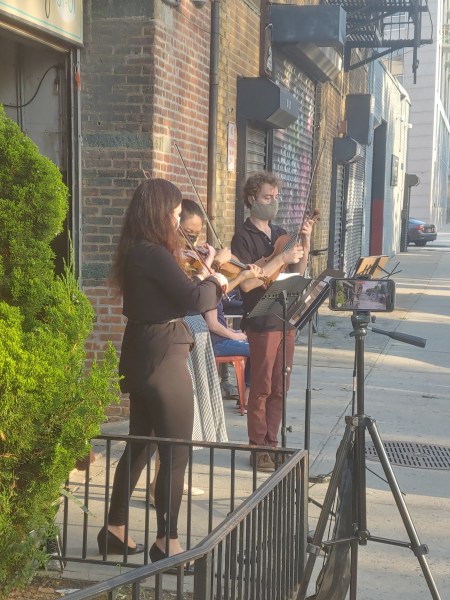
The string players launched into I Can’t Help Falling in Love with You, alternating the melody line, first the pizzicato, then the legato. We all grew very still and drank it in. We knew we were lucky.
 Elizabeth Bales Frank
Recent Comments