A Sense of Place

Hello readers:
As one of the recipients of a #NYCArtist Corps grant, I did a reading last weekend of my work in progress, “40 Days at the Dog Cafe,” at the market adjacent to the dog cafe, Marche le Woof. After my reading, I conducted a workshop called “A Sense of Place,” inspired by the fact that I was inspired by the dog cafe, Chateau le Woof, to begin writing about my changing neighborhood, over the summer.
I am toying with the idea of offering a regular, free, low-key generative writing workshop for writers of all levels. The workshop was my favorite part of an already rewarding day. Here is the “teacher’s edition” of the handout I provided the participants. Let me know what you think in the comments.
A Sense of Place
A Chateau le Woof workshop
When we read stories, we often don’t think of place as a primary element. In the earliest stories we heard, place hardly mattered at all. The story happened in a place – far away? enchanted? A kingdom? A village on the edge of a dark forest? A cottage by the sea? We had just enough to orient ourselves.
When we think of stories, we think of plot, characters, and the rise and fall of action. If we think of place at all, we think of where a story “takes place.” To Kill a Mockingbird takes place in Alabama, or, if you move in, in a small town in Alabama where everyone knows everyone else, or, if you move in more closely, on the front porch of the Finch household and in a courtroom.
A Game of Thrones takes place in the Seven Kingdoms, in Westeros, in King’s Landing, and in the throne room where the frankly ugly chair that everyone is fighting for actually sits.
But I’d like to explore how place can serve a story. How it can act as character, or metaphor, or place setting. Place setting is most common in the movies, where a bleak western landscape or a busy heartless city can set up a conflict for the hero. something to conquer.
But place can also be one of the main characters. the examples below are from essays. Let’s see how descriptions of place can be used.
PLACE AS CHARACTER
Somehow you are supposed to teach yourself how to comprehend Hong Kong’s energy and flash contradictions; Asian and Western; the encroaching Chinese mainland and the remnants of England; the greasy night markets of stick-rice tamales and knock-off leather boots that slouch right across from Tiffany, Chanel, and Prada. The only things common to these are the offices sending air-conditioned blasts into the street, a kind of longing for money, and, most important, the sense of storytelling that the city seems to require as a visitor’s pass. Hong Kong has a way of turning on your internal monologue. Walking becomes an act of silent storytelling, figuring people out. You feel like you are lost in some prelapsarian novel in which the plot has begun but the characters wait for you to name them. In some time, at some place, we step into an underground Cantonese restaurant and I see a grey-suited, red-tied man act like a parody of the States. American, I say, with an American accent: good-natured smiles, occasionally the slow English dispatched on foreigners and children, and a slightly uncomfortable look, as though he’s worried he’s outnumbered.
Ken Chen, “City Out of Breath,” 2005
This essay by Ken Chen describes a visit he made with his father to Hong Kong. His father spoke Mandarin but not Cantonese. Is Hong Kong a character? Perhaps an antagonist?
Once I loved a man who was a lot like the desert, and before that I loved the desert. It wasn’t particular things but the space between them, that abundance of absence, that is the desert’s invitation. There the geology that underlies lusher landscapes is exposed to the eye, and this gives it a skeletal elegance, just as its harsh conditions—the vast distances between water, the many dangers, the extremes of heat and cold—keep you in mind of your mortality. But the desert is made first and foremost out of light, at least to the eye and the heart, and you quickly learn that the mountain range twenty miles away is pink at dawn, a scrubby green at midday, blue in evening and under clouds. The light belies the bony solidity of the land, playing over it like emotion on a face, and in this the desert is intensely alive, as the apparent mood of mountains changes hourly, as places that are flat and stark at noon fill with shadows and mystery in the evening, as darkness becomes a reservoir from which the eyes drink, as clouds promise rain that comes like passion and leaves like redemption, rain that delivers itself with thunder, with lightning, with a rise of scents in this place so pure that moisture, dust, and the various bushes all have their own smell in the sudden humidity. Alive with the primal forces of rock, weather, wind, light, and time in which biology is only an uninvited guest fending for itself, gilded, dwarfed, and threatened by its hosts. It was the vastness that I love and an austerity that was also voluptuous. And the man?
Rebecca Solnit, “A Field Guide to Getting Lost,” 2005
This essay by Rebecca Solnit describes a landscape and a love affair. She ends the passage with the question, “and the man?” but what do we already know about the man, from the way she described the desert? Is he fat or lean? iI the sex good? Is he emotionally available? What clues do we have?
PLACE AS TABLE-SETTING
In the bar up ahead waitresses slam sloe-gin fizzes down on wet tables and men point pool cues at each other in the early stages of drunkenness. The singer in the three-man band whispers test into the microphone and rolls his eyes at the feedback. The sound guy jumps up from a table full of ladies and heads over to turn knobs.
We crunch over the parking lot gravel and wait for our song to finish. I’m over my head, but it sure feels nice. The bar is low and windowless, with patched siding and a kicked-in door; the lot is full of muscle cars and pickups. A man and a woman burst through the door and stand negotiating who will drive. He’s got the keys but she looks fiercer. In the blinking neon our faces are malarial and buttery. As the song winds down, the drama in front of us ends. He throws the keys at her as hard as he can but she jumps nimbly out of the way and picks them up with a handful of gravel, begins pelting his back as he weaves into the darkness.
Jo Ann Beard, “Cousins,” 1995
Where are we? When are we? What do we make of the fact that the writer describes what’s going on in the bar before she and her companion even arrive? What kind of evening is going to unfold, and how do we know?
PROMPTS
1.
Whenever the experiment on and of
My life begins to draw to a close
I’ll go back to the place that held me
And be held.
Jane Mead, I Wonder if I Will Miss the Moss
Write about a place that held you, how it held you, what it felt like to be held there.
2.
Art is energy, held in a form long enough to be experienced.
Kim Addonizio
Write about a place the gives or gave you energy, that inspires or inspired you. (It doesn’t have to be artistic inspiration – it could have inspired you to make a move, or a declaration.)
3.
Write about anything you like.
Boats Against the Current
And still we keep on creating, though myself not as much I would like of late. Lacking friends with benefits, I turned earlier this summer to friends with books out.

Marcia Trahan’s memoir Mercy: A Memoir of Medical Trauma and True Crime Obsession explores her own medical ordeals, her obsession with true crime on television, women’s bodies as commodities in society, and her own identity. Sue William Silverman’s How to Survive Death and Other Inconveniences, a memoir in essays, explores assault and addiction, and masterfully illustrates how trauma can stalk a person’s life, sometimes in brief shadow, sometimes in full-blown flashback.
I like to call Lee Martin’s recent fiction “Southern Illinois Noir,” although whether he likes me to call it that is not something I have asked. In his recent novels and story collections, momentarily untethered people make rash decisions that lead to outsized consequences; sometimes, as in his recent Yours, Jean, based on a true crime, an entire town acts as both chorus and cast.
There has been little progress on my own work, except for publicity for and correction of the proof of Censorettes. While I have little to complain about (I know; I am lucky!), how rarely that stops me. I am able to work from home, and I am putting in more hours than ever, including Sunday afternoon, which at least provided peaceful, uninterrupted time. I am attending a virtual writing conference next week, and need to get my day job ducks in a row.
Once I was done, a walk to the park was in order. My new favorite place is Chateau Le Woof, because I love the ingenuity the owners had of turning a former industrial parking garage into a dog-friendly cafe, open to the street, across from the park. On the way there, I met a woman and her dog. The owner and I nodded, but the dog did a full-fledged double take and pulled her back to where I was sitting. “YOU AGAIN!” he would have cried, had we both been human, and cast in a romantic comedy where in an earlier scene I would have stolen his parking spot, or spoiled some meticulously prepared model just before the big presentation. He gazed at me with ardent brown eyes through dirty white fur.
“Hi,” I said to the dog, as his owner tried to break his stare and pull him along, chuckling apologies to me. I said to the dog, “Hot out, right?” and then, as a man walked by, “Okay, I’m really not that interesting. Try that guy.”
Because of allergies, I’m not a petter of strange dogs, particularly ones who regard me like an antic Cary Grant regarding the leopard, if not Katherine Hepburn, in Bringing Up Baby.
Then, I said to the dog, “Alright,” and got up to walk with them to the park.
“You a Vermonter?” asked the woman.
Strange question, I thought, until I looked down and realized I was wearing a Vermont t-shirt. I still think it is a strange question. People don’t necessarily wear t-shirts advertising their home, so they can be returned if life becomes wayward. People visit places and buy t-shirts to show they were there; there is even a cliché about it. But I once wore a t-shirt I bought in Canada on a Brooklyn riverside bike tour, and people kept asking me what province I was from, or telling me how much they liked Quebec.
The woman was herself from Burlington. I told her, then, about Vermont, how I attend the Vermont College of Fine Arts Postgraduate Conference in Montpelier, Vermont every summer (where I met the above authors, Lee, Marcia and Sue), how this year it is virtual, which means I am not at my picnic table on the town green at the top of the hill, or hanging out in the Cafe Anna with my friends, but in my apartment, in my same crippling home desk chair, a captive of Zoom, with pandemic hair and bad lighting (I know; I am lucky!)
Maybe I am a Vermonter.
We turned the corner on Vernon Boulevard, where some string players were entertaining an insufficiently socially distanced group and their dogs.
My canine love interest took off across the park, a sculpture park, which is currently home to this monolith.

“Because Once You Enter My House, It Becomes Our House,” by Jeffrey Gibson. Read more about it here
The music of the strings lured me out of the park and I stood among my insufficiently socially distanced neighbors, enriched that day by so much heat and creativity. We are isolated; still, we create. We are ordered to keep a distance; still, we connect. We experience ordeals and suffer from bad decisions; still, we write books (albeit ones with blood-splattered covers).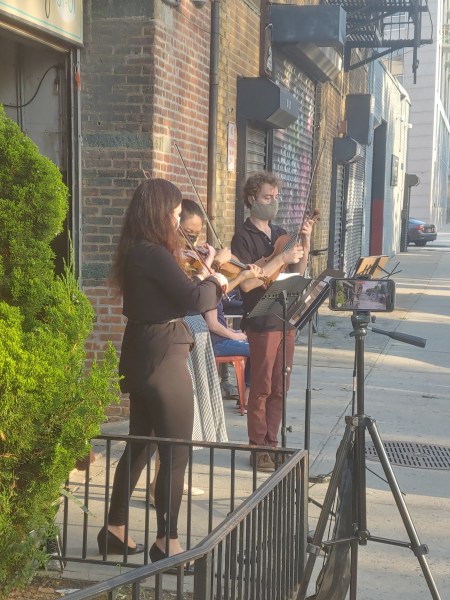
The string players launched into I Can’t Help Falling in Love with You, alternating the melody line, first the pizzicato, then the legato. We all grew very still and drank it in. We knew we were lucky.
History Dames
Last night I went to the 92nd St. Y to see Hilary Mantel with Jeremy Herrin, who is the director of the upcoming Broadway production of Wolf Hall, in a conversation moderated by Candice Bergen, who wore bright red laces in her high-top sneakers. I was invited by my friend Leslie, who has invited me to at least a dozen things this quarter (she is quite the culture vulture) but due to my schedule of day job as a researcher, writing and grad school, I have always said no. Hilary Mantel was too good to pass up, however. And she did not disappoint.
I hadn’t planned to take notes, but she kept saying such interesting things. As a historical novelist myself (and yes, I realize what that sounds like, putting myself in the same paragraph with Dame Mantel), I have had a recent problem with two of my characters, Nick and Daisy, frisking around in the attic of my brain when I am meant to be doing homework. Where were they during winter break? (To be fair, during winter break, I was polishing the novel I am now trying to sell, Do Nothing Till You Hear From Me, and the characters barging into grad school studying are the fresher (in the sense that I haven’t been writing them for SEVEN YEARS), fiestier characters from Untitled Berlin Love Story.
“I had wanted to write about Thomas Cromwell for more than thirty years,” Dame Mantel said, which made me feel slightly better about my seven, and also prompted me to reach into my bag for a notebook and pen. We must remember when writing historical fiction, she said, that we are writing “characters who are ignorant of their own fate . . . [unaware that their choices] have cascades of consequences that go down through generations. They’re not people in history. They’re people in their lives.”
As a researcher, I was gratified to hear Dame Mantel state that the does her own research and has no assistants. “How do you know what you need to know until you come across it?” she asked, adding that research is “a devious process. I don’t see how you can delegate it. The research is just as creative as the writing itself.”
As for how she does what she does: “A novel is an inherently unpredictable thing.” and “I write in scenes and I put it together like a collage.” (She is currently writing the third volume in the Cromwell trilogy, The Mirror and the Light.) When questioned about her “routine,” she said “I don’t really understand writing routines. I am writing 24 hours a day, 7 days a week. Nobody gives you a holiday. You take your sensibility with you everywhere.”
This was gratifying as well, since I remain bruised from an interrogation a couple of years back by a leader of a short-term workshop I was in, who demanded that I explain my “practice.” What room did I write in, did I write first thing in the morning, did I set aside a time every day? This same woman was initially delighted that I was going to start graduate school, but then horrified to learn that I did not intend to quit my job to do so. “When will you have time to write? You’re a WRITER!” How, um, I asked her, did she think I was going to pay for grad school without a job? “Can’t you get a grant? You’re a WRITER!”
She is a child of the 60’s but even so. In the 60’s, was there an abundance of grants which provided housing, food, medical insurance to women of an age more likely to have children in grad school than to be in grad school? But then, we were obviously of different mindsets. For one thing, the workshop was in “flash fiction,” which I don’t read, don’t understand and, as it became apparent, can’t write. For another, I don’t “practice” writing, as it is not law, medicine, or religion. I write novels. I take my sensibility with me everywhere.
And a novel is an inherently unpredictable thing.
 Elizabeth Bales Frank
Recent Comments