Art vs. commerce is one of the themes of my work-in-progress and also the theme of this week and the next, where the job where I participate in commerce is subsidizing the job where I participate in art in what is known as a “staycation.” In plainer terms, I took two weeks off to work on my book and stayed home to do it. After two experiments with cute little towns upstate where an enterprising artist type offers a room in a garret, I realized I needed to be with my books. (“Can’t you just bring them?” asked a friend. No. They fill an entire case.) I also needed research libraries and I write to you from the Rose Reading Room at NYPL, having been earlier to the Frick Art Research Library where the book I wanted was offsite but did you know you could just register for a card with the Frick Art Research Library? I mean, it’s a research library, meaning, you can’t roam the stacks, and you have to put your belongings in a locker and write with a pencil and all the other restrictions but also . . . a quiet room in which to write in a mansion on 71st Street, somehow free.
But to take a little break, yesterday I visited Clinamen, an installation currently on view at the Park Avenue Armory. The artist is Céleste Boursier-Mougenot who, according to the flyer provided by the Armory, creates dispositifs – orchestrated environments that expand the notion of the musical score . . . using a wide variety of situations and objects to reveal their sonic potential and generate spontaneous, live, acoustic forms.”
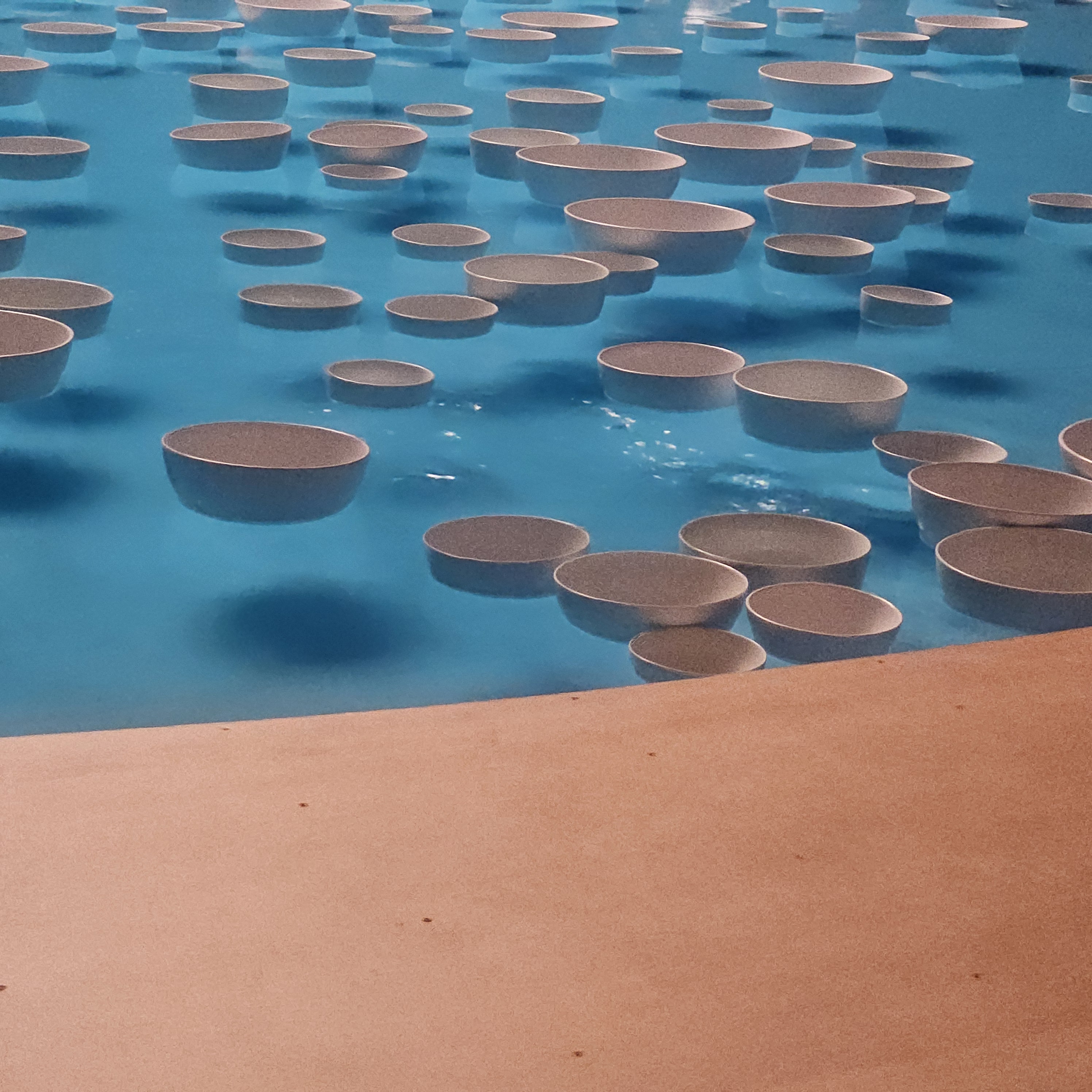
This installation features “circular basins filled with water in which ordinary porcelain bowls, selected for their distinct timbre, drift freely and gently collide to produce chiming sounds.”
I entered the vast, echoey hall (this is why theater is bad here, in my opinion) of the Armory and waited quite a long time for my eyes to adjust to the darkness and my ears to adjust to the sound. There are three deep pools in which the water is propelled by gentle motors and the bowls clang into one another. I thought, perhaps foolishly, that most people would be elsewhere on a pleasant Wednesday afternoon, but the large venue was quite crowded. Most people understood that what they were witnessing was an acoustical installation, which required oh, I don’t know, less gossiping about your daughter-in-law’s baby shower logistics and more listening. I stood up from my first pool position and walked to the second pool where at least the distracting conversation was too low for me to hear the details of it. But the third pool was just right.
I was reminded of the wind chimes that used to pong pong pong in Socrates Sculpture Park, stirred by breezes from the river. I also thought of the phrase found music. After settling in by the third people, where certain attendees had chosen to embrace the sound to the point of lying on the floor with their eyes closed, I could hear the echoes of the clangs from the bowls in the other pools. Because of the high ceiling in the Armory and the way the sound carried, it sounded like the church bells of a neighboring town. The soft collisions in the pools nearest me produced a noise that sounded more like chimes.
When the bowls reached an intense congregation, the sounds they produced most resembled a melody.
“Congregation” is a concept I came up with recently when asked to describe my work in progress. “A meditative history of one block in my neighborhood,” didn’t seem to be cutting it, even when I added, “The block functions as a microcosm of American history – the Puritans, the rise of the merchant class, the rise of public art.” (“But why that block?” someone asked. “Why not a block in, say, Ohio?” Some people like to dispute, I have realized.)
When the Halletts arrived at Hallett’s Cove, which forms the north end of the block, they were Puritans. By the time they died, they had become Quakers, a faith which has an entirely different concept of what constitutes a “congregation” – more along the lines of where Jesus says in the Book of Matthew “For where two or three are gathered together in my name, there am I in the midst of them” rather than being scolded from a pulpit by a minister telling you that you were born in sin and will probably spend eternity in Hell but better live a pinched, dour existence in the meantime, just in case.
The piano factory, which is in the middle of the block, produced pianos for the home, rather than the concert grands produced by the Steinway factory around the curve of the Hellgate. “Made by our family for yours,” was one of the mottos of the Sohmer piano factory, in the days when families would congregate around the piano after a meal to sing together.
And Mark di Suvero (whose studios are on north end of the block) and Isamu Noguchi (whose studios, on south end, are now a museum) designed the Socrates Sculpture Park, across the street from the former piano factory. Both of these contemporary sculptors were driven by the concept that art should be available to everyone, not sequestered, and that it should encourage congregation. Both men designed both playgrounds and sculptures for children to climb on.
Finally, the dog café, housed on the ground floor of the former factory, is where people came to congregate during the pandemic, when one of the many difficult aspects of life was that we were not supposed to breathe the same air.
I was reminded of this when I reluctantly left the pools of the Armory to return to the bright, shrill Upper East Side. The “please stand six feet apart” stickers were still visible on the sidewalk wrapping around the Armory. But inside, one was reminded that close proximity could sometimes produce a sound resembling a melody.


It’s so cool to see you actually doing this – and great to receive your letter 🙂
LikeLike